Leadership
When a rep leaves, the customers shouldn’t
You’ll replace the salesperson. What’s harder to replace is everything they knew about your customers and never wrote down.

Chris was your guy. Six years on the floor, knew half the town by first name. He sold the Hendersons their last three cars and could tell you which one of them actually made the decision. Then he took a job at the Toyota store up the highway.
You lost a good salesperson. That stings, but it’s fixable: you’ll hire. What you really lost is everything Chris knew and never wrote down.
Turnover is normal. The knowledge loss doesn’t have to be.
Salespeople leave. NADA’s workforce study put sales consultant turnover at 66% for 2024, up 12 points from the year before. That isn’t a knock on anyone. It’s a commission job, it’s hard and good people get recruited.
So the useful question isn’t how to stop turnover entirely. You probably can’t. It’s what stays behind when someone goes, and at most stores the honest answer is not much: a CRM record with a phone number, a vehicle of interest and some activity entries.
What walked out with Chris
Think about what your best rep knows that isn’t in any system. Who in the household signs off. Which customers hate phone calls and only answer texts. Who’s been “almost ready” for two years and who means it this time. Whose lease is up in the spring. Who got burned at another store and needs to go slow.
That’s the difference between a call that feels like catching up and a call that feels like a stranger reading a screen. When a new rep inherits Chris’s book, they call those same customers cold, and the customers notice. Some follow Chris up the highway. Some just stop answering.
Meanwhile, Dana starts Monday
Dana is smart, hungry and completely willing, and for the next few months she’ll be learning on your customers. She doesn’t know how your store handles the trade conversation yet. She doesn’t know what to say when someone brings up a quote from across town. She doesn’t know the customer she’s calling has been in three times already.
None of that is a talent problem. It’s an information problem. She just hasn’t had time to collect what the veterans picked up over years.
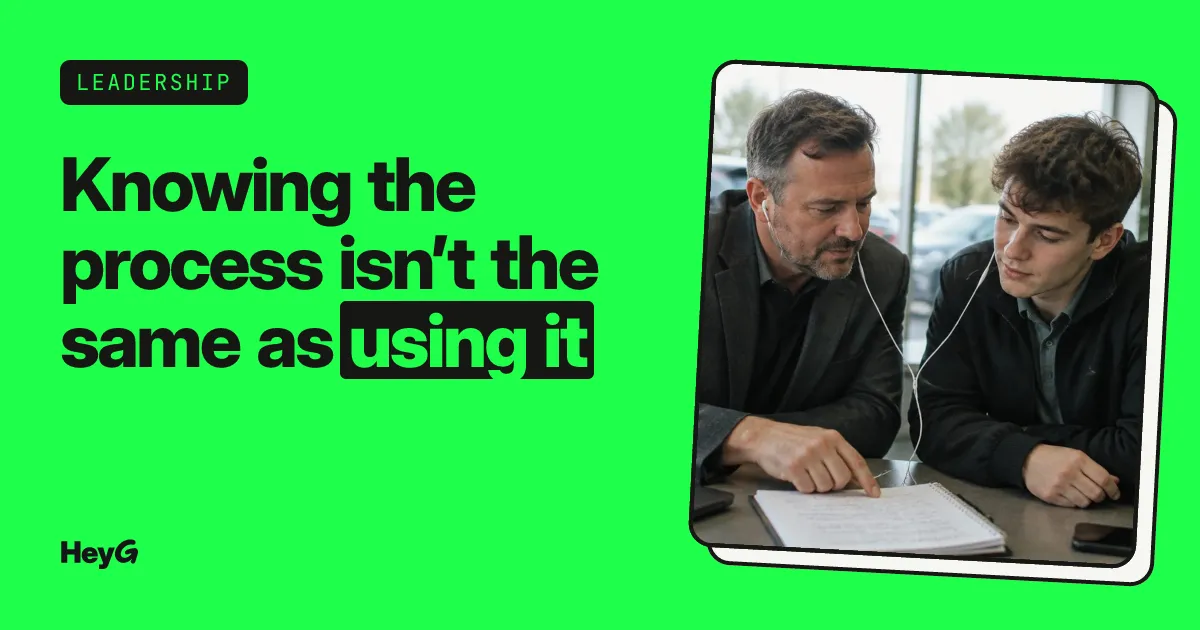
Most stores answer this with training: shadowing, role play, a binder of word tracks. All good. But the moment that matters is the actual call, and nobody’s sitting next to Dana when the customer says “I’m just looking.” The metric worth watching isn’t how many modules she finished. It’s how long it takes before she sounds like she’s been there for years.
An exit checklist that takes an hour
You can’t stop the next Chris from leaving, but you can make his last week count.
- Go through his open customers while he’s still in the building. Even an hour of this is worth more than a week of digging later.
- Capture what matters, not everything. “Wife decides. Wants to stay under current payment. Comparing one other store.” That’s a handoff. A page of activity isn’t.
- Introduce the new rep by name. A short text from Chris saying Dana will take great care of them keeps a lot of customers from drifting.
- Pass on the words, not just the rules. “Always ask about the trade” is a rule. How Chris actually asked is a word track, and word tracks stick.
Keep the people, and keep the story
You’ll keep working on retention, and you should. Pay plans, culture and schedules all matter. But plan for the day your best rep leaves anyway.
That’s a big part of why HeyG exists. Calls and texts land on the customer’s profile, so the story belongs to the store instead of one rep. When Chris leaves, Dana opens the Hendersons and sees who weighs in, what they care about and what happened last time, in plain language. On her calls, she gets guidance built around that customer while she builds her own instincts. For the customers, the handoff barely shows.